
Several serious men
The year is 1935. You are two years old │Non-Fiction │Text

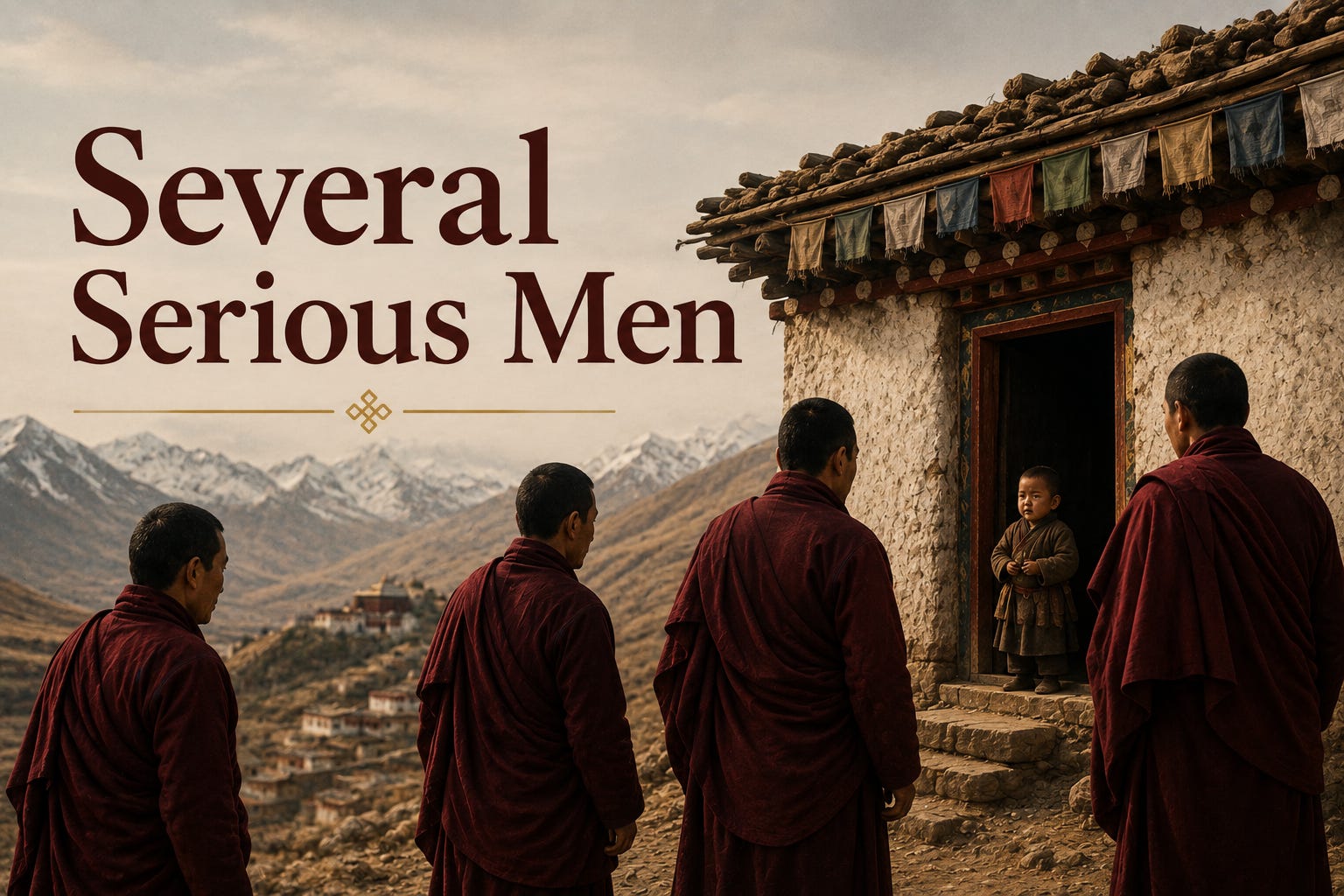
The year is 1935. You are two years old and several serious men are looking for you.
You live in a small village in northeastern Tibet. You are the fifth child of sixteen born to peasant farmers. Only seven of you will survive to adulthood.
Your name is Lhamo Thondup, which means “Wish-Fulfilling Goddess”, which is a lot of pressure to put on a toddler.
Your early years are ordinary. You collect chicken eggs. You play with whatever is lying around. You spend an oddly large amount of time packing and unpacking a little bag because you’re convinced you’re going on a long journey.
You do not go on a journey of any length.
You demand to sit at the head of the table at mealtimes. You will say this was because you already knew you were destined for greatness. It seems just as likely that it was to annoy your father, whom you describe as a man of medium height and very quick temper who hits you when you pull on his moustache.
Two years before you were born, the 13th Dalai Lama, Thupten Gyatso, died. When one Dalai Lama dies, senior monks go looking for him again. They consult oracles, interpret visions and hunt for clues.
During the mummification of the 13th Dalai Lama, his head turns from facing south to facing northeast. Then the Regent looks into the waters of a sacred lake and sees three Tibetan letters: Ah, Ka and Ma. He also sees a three-storey monastery with a turquoise and gold roof. Then a small house with strangely shaped guttering.
This will be, by any standard, a fairly demanding house hunt.
Eventually, when the monks see the gnarled juniper branches on the roof of your family home, these serious men become convinced they have found the right place.
But they cannot simply knock on the door and ask, “Hello, can the reincarnation of the Dalai Lama come out and play?”
That would give the game away. Instead, the leader of the search party, Kewtsang Rinpoche, disguises himself as a servant and asks to stay the night.
You ask for his prayer beads. They are beads you used to own. This is encouraging. Further tests begin. The men place two walking sticks in front of you. You pick one, change your mind, then point to the second.
“It’s mine,” you say. Or they say you said.
And apparently it was. You are now the Dalai Lama. Congratulations, I guess.
You are separated from your family, your village and everything you’ve ever known and taken to a monastery to begin your education. The little bag you’ve been packing and unpacking for months is finally on the move.
You are enthroned as the spiritual leader of Tibet on the 22nd of February 1940. Your throne is quite large.
You are four years old.
When you are fifteen, China invades Tibet. Nine years later, after years of growing tension and protests, you flee across the Himalayas into India and begin a lifetime of exile. You establish a government in Dharamsala.
This is, on paper, a demotion.
There, you study, write and give speeches and your fame grows. You meet presidents and prime ministers and many people who have never been remotely interested in Buddhism but are thrilled to meet the Dalai Lama.
You do well in your role and in 1989 win the Nobel Peace Prize. Not bad for a boy who spent his childhood pulling moustaches.
You are ninety-one now. You have spent your entire life being told who you are. First by the monks who found you. Then by Tibet. Then by China. Then by the rest of the world.
Your job will be even harder on your next go around the Dharma wheel. You haven’t been able to solve the China-Tibet problem. China now claims the right to decide who the next Dalai Lama will be.
Years ago, I researched your story for a book chapter. The absurdity of your origins stayed with me. When I became a parent, the tenor of your story changed. I no longer saw the absurdity in it, only the cruelty. How what happened to you is an extreme form of what happens to all children.
Surprisingly little of childhood actually belongs to the child. How we choose not only their names before they are born, but also where they live, the language they speak, the milieu in which they will grow up, and the day care and schools they attend.
We tell them they can become anything they want, but by the time they are old enough to decide what they want to become, we are invested in their choices. And we have subtly (and not so subtly) influenced their desires.
We do this without consulting any oracles. Or staring into any sacred lakes. Or examining the direction of the smoke from a cremation.
Mostly, we just say things:
You’re the clever one.
Why have you gone all shy again?
Our family aren’t really maths people.
You can’t make a living doing that.
Sometimes we’re right, other times we’re wrong. It doesn’t matter much which because children are extraordinarily absorbent. They collect our descriptions and carry them around as if they’re facts.
Children are not things we make. While we can’t help but shape them, we don’t have the right to decide what they become.
One of the hardest challenges of parenting is leaving enough space for a person to emerge who is not the person you imagined. Or secretly hoped for.
Somewhere, right now, another child is collecting eggs. Near them is a little bag they pack and unpack. One day, several serious men will start looking for them.
I hope they don’t find them too soon.
I hope they never find them.
I hope that child gets to spend as much time as possible being nobody in particular.
Before the rest of us decide who they are.