
What Losing My Daughter for Two Minutes Taught Me About Hating Myself Forever
It happened three years ago. She has never let me forget it. │Non-Fiction │Text

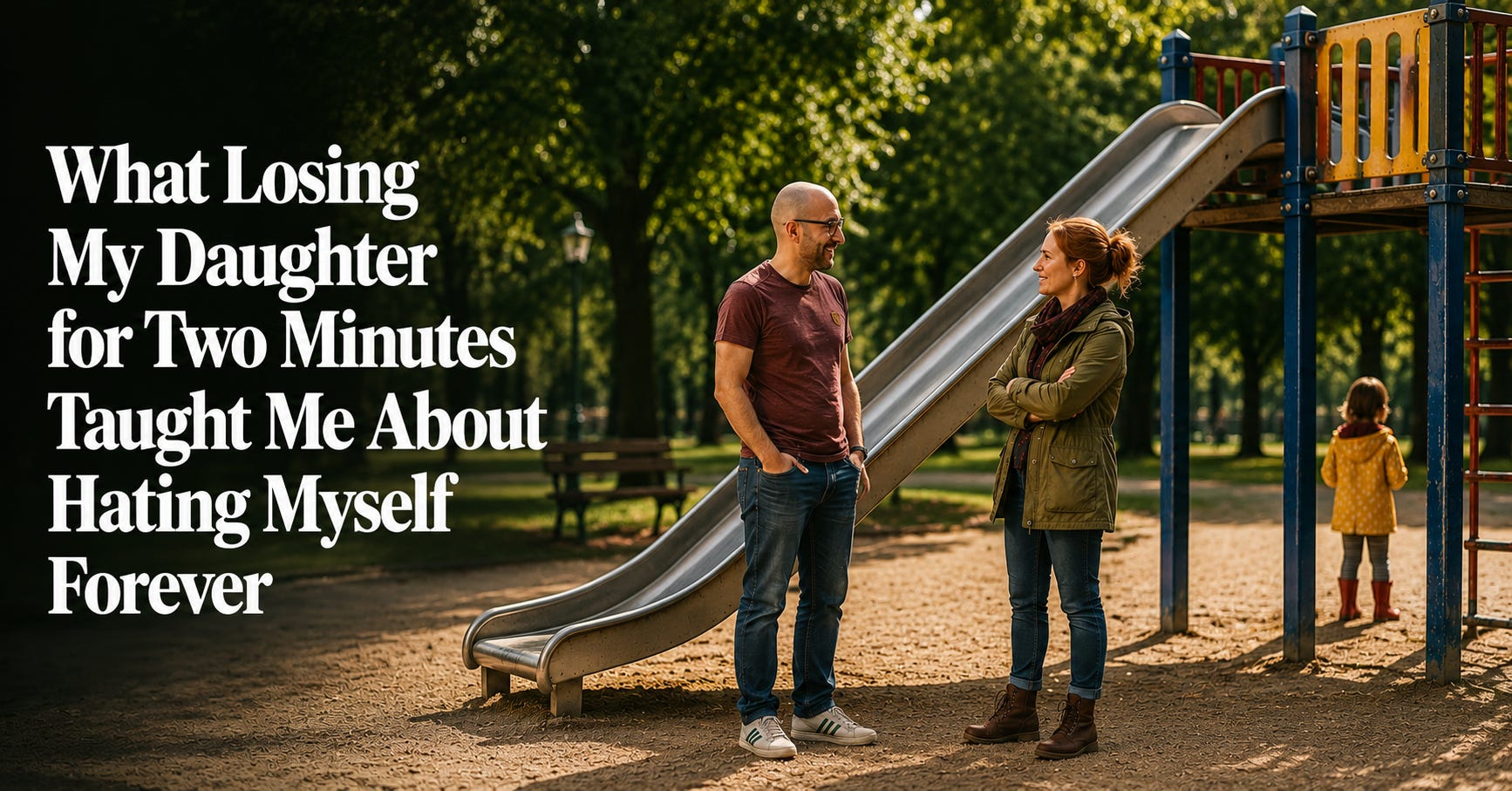
I heard her crying before I saw her. She was soaked from the rain, cheeks streaked with tears, panicked, letting go of a redheaded woman's hand and running towards me, wailing, “Papa! Papa!”
She crashed into my chest, shaking. “You lost me.”
I was standing under a high slide with my friend, Nadine. We’d shifted there two minutes earlier to avoid sudden drizzle. We were one metre away from where my child had last seen us—still technically in sight, just not in hers.
“Oh honey,” I said, hugging Runa as hard as possible—feeling heavy in my bones, feeling like a big lump of microwaved crap, feeling like a horrible person. The redheaded woman approached slowly, exuding the serene confidence of someone who has never misplaced anything in her life, let alone a whole human child.
“I found her crying,” she said, motioning to the monkey bars, all of four metres away.
It was a distance so small, not only could I have thrown a stone and hit it, but Runa could have too.
“Thank you,” I said. “We just moved a little bit because of the rain.”
“Hmmm,” she replied. “Yes. You really do have to pay attention.” She looked down at Runa. “She kept saying ‘papa’ but I figured she was confused and so I walked her around looking for her Mama. Then she ran to you.”
Sexist, I thought, but didn’t say.
“Terrible,” Nadine said, lowering and shaking her head like she was attending a funeral for my parenting skills. “Poor Runa.”
“Thanks again,” I said, to this woman, upon whom I had soured. She, who had made my child more lost by dragging her away from me in search of her own bigoted maternal stereotypes.
The woman/self-appointed saviour gave a partial bow, which seemed extreme. “We’re all in this together,” she said.
Yes. All us mothers.
“Nice lady,” Nadine said as the woman floated away on a cloud of magnanimity.
“Shut up,” I said, stroking Runa’s hair. “I’m so sorry, honey. We were just here. We were just under the slide.”
“You lost me,” she said, between heaving, guttural sobs as if fear was scooping out her insides with a melon baller.
“We lost each other,” I corrected.
“Poor little thing,” Nadine said, stroking her arm. “You must feel terrible?”
“Me?” I spluttered. “It was two minutes. It was nothing.”
But it wasn’t nothing; it was everything. That night, Runa refused to sleep alone. Then she stopped sleeping through—no matter where we put her. Would wake up shrieking. Wouldn’t even go get a toy from another room unless we came along as her security detail.
Also, she brought up the incident constantly. “You lost me,” she’d say again and again.
“We lost each other,” I’d correct.
“I don’t want to be lost.”
“We’re in the living room, honey. You’re not going to get lost.”
“You lost me,” she’d repeat, slipping the noose tighter around my neck.
“For like a minute, tops.”
“I was crying,” she’d say, often while crying, creating a recursive trauma loop. “The woman helped me.”
“Yes, she hinder—helped you.”
“Papa lost me. You lost me.”
IT WAS ONE TIME, I wanted to scream. AND I AM SUCH AN INCREDIBLE DAD. DO YOU KNOW HOW MANY CHILDREN CALL FIRST FOR PAPA WHEN THEY GET HURT? NONE, KID.
EXCEPT YOU.
AND YET HERE I AM—ON TRIAL IN THE COURT OF YOUR TINY, WET, JUDGMENTAL FACE. WHICH IS LOOKING AT ME LIKE I ABANDONED YOU IN THE WOODS TO BE RAISED BY WOLVES.
“This is the worst phase ever,” I said, staring up at the ceiling one night, as my partner, Evelyn, and I were in bed. Runa was asleep between us, spinning like a Dutch windmill, tortured even in her slumber by the sharp memory of my neglect.
“It was such a tiny thing,” I whispered.
“Well,” Evelyn said. “You did lose her.”
“I know that,” I barked. “Everyone is making me very aware of that.”
“Well,” she said.
“And we lost her together, remember?”
Two years earlier, when Runa had just started to walk, we lost her at a museum for like twenty minutes. The whole place got involved. Walkie-talkies. A lockdown. The police on red alert.
“That’s different,” Evelyn said.
“How is it different?”
“She’s forgotten about that.”
She didn’t forget about this. Every “you lost me” was a dagger to my heart. Parenting is a slow-motion heartbreak. A never-ending series of losses—the last crawl, the final midday nap, the disappearance of “bawana” in favour of “banana.” How each new version of your child murders the old one in the night. The truth was that I lost her each and every day and would keep doing so, until I closed my eyes for the last time, losing her forever.
That was loss. Loss I knew. I’d priced it like in some kind of morbid actuary.
This was something else. Something I wasn’t ready for: guilt.
Parenting is caring for someone who can’t care for themselves. And when you fail, as I had failed, you can do real harm. The size of the failure doesn’t matter. Only the size of the hurt.
Guilt sits inside you, rotting you from within.
I was the perfect father for weeks, trying to get rid of that guilt. Hide and seek was out, too triggering for us both, but no parent on earth was more present during Plush Toy Picnic. I stopped sneaking looks at my phone during Peppa Pig. I was so emotionally available I was the dad from Inside Out.
Nothing helped. Guilt isn’t rational. Doesn’t respond to logic or reason. Doesn’t care about your otherwise impeccable parental résumé.
I once saw a documentary where a detective said, “We can make a hundred mistakes, but if the criminal makes just one, we catch him.”
And this is why parenting should be illegal. There’s just no way to do it without committing serious emotional crimes against the people you love most in the world. Every time Runa said, “you lost me,” it wasn’t a statement—it was a verdict. A reminder of my lifetime sentence, with no hope of parole, handed down by a judge who still needed help wiping her own behind.
“We’re never going to know,” I said to Evelyn, in bed again, Runa still sleeping between us. “What the things are that are going to matter. Which mistakes she’ll forget, and which will blow up the family, and ruin her life forever.”
“I know,” she said. “Every parent knows that.”
“How is that fair?” I said. “That’s not fair. That’s a shitty deal.”
“Did you just figure this out?” she asked.
“Yes,” I said. “I did.”
“Oh. Right. Sorry.”
“Can we put money aside for her therapy?” I asked.
“You can put your money aside, yes.”
A week later, I tried to drop Runa off at Kindergarten. Before drizzlegate this had been easy. Now, it involved a tremendous amount of begging and screaming and pleading and demanding and whimpering. On this day, all the staff got involved, as did half the children, forming an emotional support conga line trying to convince Runa it was safe to let go of my leg.
“Poor little lady,” Inka, her teacher, said, during her second attempt.
“I don’t know what’s going on,” I said, even though I did, and that it was all my fault, and would always be my fault, forever, and that my only relief from the guilt would be death, which I was starting to look forward to.
“It’s normal,” Inka said.
“It’s like she’s suddenly afraid of everything,” I said, not revealing the reason why—that I was the reason why.
Another mother was there, dropping off her child with no fuss. “The fear phase,” she said knowingly. “We had one of those.”
“Yeah,” Inka said. “Always happens around age three. It’s developmental.”
“I’ve got to go,” I said, kicking my leg violently to shake Runa off and running out of the door and all the way home. Four flights of stairs. Bursting into the living room, victorious. “IT’S NOT MY FAULT,” I bellowed. “IT’S A THING. A PHASE. DEVELOPMENTAL. I AM EXONERATED.”
This was only partly true but in the world of parenting, we take our wins where we can find them—even if they’re hiding under a slide, trying to avoid the rain. Evelyn looked up from her laptop. “Really?”
“Yes. I have nothing to feel guilty about,” I declared, trying magnanimity on for myself. I liked its fit.
She raised an eyebrow. “Nothing?”
“Nothing much,” I said, understanding that guilt will always be there now, like loss. That they’re parenting’s twin shadows. Part of the deal you make when you sign up for the gig—blind, of course, with no real understanding of what you’re agreeing to and how often it’s going to make you hate yourself. I would face the guilt. I would own it. And I would keep turning up regardless, trying to be better.
From that moment on when she said “you lost me,” rather than defending or deflecting, I replied, “Yes, I did. But then I found you again. I will always find you again.”
Until next Friday…
Adam
PS If you’re interesting in this topic, I have a series of three books about the emotional side of fatherhood. They’re called Dad Differently (UK link, US link).