
Why Having a Child Made Me Feel Better About Myself — But Worse About Everyone Else
Non-Fiction │Text and Audio

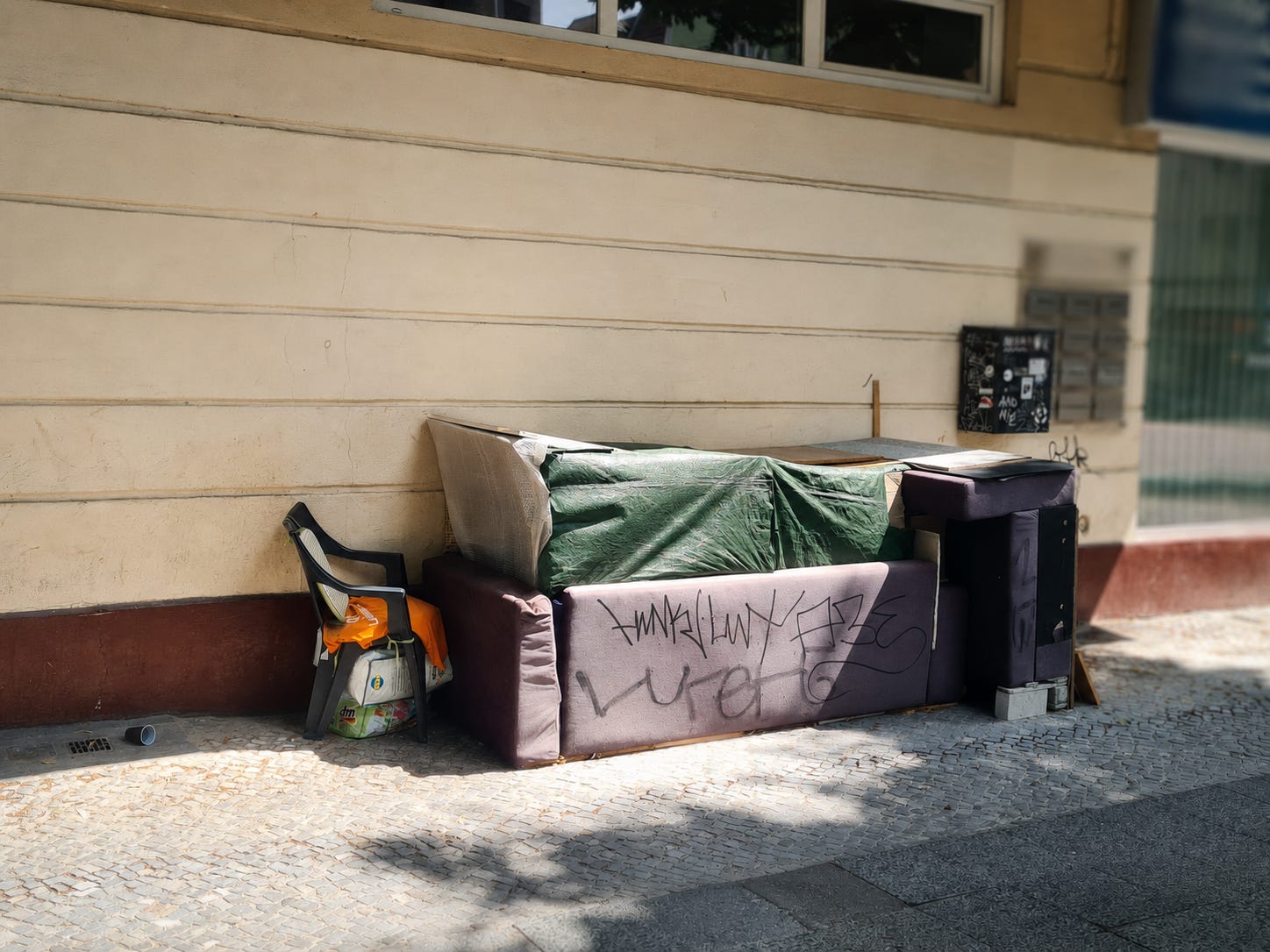
“Is he home?” my daughter Runa asked, craning her neck as we passed the man sleeping in a shack of his own construction. He’d been at the end of our road for months. She checked for him each morning, like you might a neighbour’s car in the driveway.
“He’s there,” I said, glimpsing his head though a gap in the roof, made of green tarpaulin and flattened boxes.
“Do you think he’s cold?” she asked.
“I think he’s cold.”
We walked on. Approached the subway. “Why doesn’t he sleep inside?”
“It’s complicated.”
“He could have my room?”
“That’s… nice,” I said. “But not really how it works.”
“Why not?”
“Well,” I said, as we walked down the steps. I tried to find an answer that made sense but was better than the truth: because I don’t want him to live in our apartment.
“We should bring him some snacks on the way back from kindergarten,” she said.
I smiled, but tucked just behind it was panic. I knew why she wanted to give him snacks: he didn’t have snacks and if we gave him snacks, he’d have snacks.
Win.
But I knew that if we gave him snacks, he’d have snacks, but still almost nothing else.
Loss.
Giving him snacks felt like underlining his misery. But then not giving him snacks when we had snacks? That felt insulting too.
In the subway, we passed a man lying in a puddle of what I assumed was probably, mostly, heroin. I waited for her to say something adorable about him, like that he “must be very tired,” but she said nothing at all, and that was worse—for it meant that she’d become used to seeing people passed out like this.
“Three minutes,” she said, looking up at the sign.
“Let’s see,” I said, because I knew that while we were in a relationship with Berlin’s BVG, it was often abusive.
As we waited for the train, I thought about how before I had a child, I was in the world, but felt no actual loyalty to it. If I found the street where I lived too dirty, or the weather above my apartment too depressing, I flew to Malaysia.
I thought of myself as someone who cared about the world, but mostly I cared about the idea of being the kind of person who cared about the world. I was always my main passion. Busy in my head being heckled by my many neuroses. My self-involvement was something I basked in, certain it would produce great art, insight, or at least interesting chat for crowded house-party kitchens.
Becoming a parent changed all that.
My world, which used to be four continents, give or take, shrunk to four streets. I came to know them well because it turns out, it’s hard to live in your head, luxuriating in your many shortcomings, when someone mostly helpless needs you to show up every single day, boringly, reliably, to warm their porridge.
“I see it,” she said, as the train shot from the tunnel. “It’s here.”
We got on. Sat down. Several people around us got up and walked to our right, away from the man who was hobbling down the carriage asking for money, and whose leg was rotting.
“Someone farted,” Runa said.
The man shuffled past. She watched him go, holding her nose.
“I think he needs to go to the hospital,” I said.
“I was born in a hospital.”
Becoming a father has changed how I see myself too. I look at my family as we eat dinner around the kitchen table. At my partner, who is almost certainly one of the world’s top five people and yet, somehow, picked me anyway. And at the person we made together, who is pure, gooey goodness. At how she looks up at me as if I’ve hung the moon for her personal pleasure. Around them, it has become so difficult to maintain the fiction that I am irredeemably awful, that I’ve had to let it go.
My focus is no longer on how I’m failing to live up to my own potential, but how the world is. Parenthood gives you the most powerful reason to fix the world and simultaneously puts you on your knees in the hallway trying to get a bright green dinosaur sock on a squirming foot.
“Three stops,” Runa said as someone gave the man some loose change.
“Yep,” I said, thinking how Elon Musk briefly had a trillion dollars—more than anyone could ever hope to spend on horse tranquiliser—and yet on this short trip to Runa’s kindergarten, we’d already passed four people with less than one euro. And that this was okay, apparently. Had to be, because I wasn’t doing anything to change it.
But then what could I do? And why was it my job? Wasn’t it the Government’s job?
My daughter was my job now. Her existence tinging mine with a persistent nagging guilt that the social contract I signed for her was worse than the one my parents signed for me. Everyone says children are the future, but that isn’t true anymore. The future belongs to the old—she’s just supposed to help pay for it.
And yet, I still signed that contract for her.
Why?
It was hard to remember when we were cuddled up in her bed looking at her books about animals, almost all of which are going extinct, because we want cheap trousers, air fryers, and schnitzels as big as your head.
At our station, we left the train.
“I want to take the lift,” she said. “I’ll push the button.”
“Okay, kid,” I said, “but use your elbow.”
My phone started jiggling in my coat pocket. I didn’t need to answer the call to know that it was a scammer, possibly human, probably AI—the technology that was either going to take all my money directly and quickly, or indirectly and quickly.
At some point I’ll need to inform her about the world so that she can navigate it alone. But I don’t want to. The greatest thing about her is her innocence. How she can’t be cynical because she doesn’t know it exists. How she doesn’t fear the void because she doesn’t know it’s right there, staring at us both.
Back on the street, we walked along, hand in hand. “Do pigeons have eyes?”
“I don’t really know what to do with that question,” I said. “Do you think they’re just like flying around without being able to see, crashing into things?”
She let go of my hand and impersonated an eyeless pigeon crashing into a micro-scooter someone had thoughtlessly parked in the middle of the path. We laughed hysterically. The scooter’s alarm beeped.
We reached her kindergarden and I breathed a sigh of relief: at least that’s over with, at least that’s done, at least I’m free again.
We said goodbye, as always, with an epic hug. I trudged back towards the subway: it’s a shame that’s over with, it’s a shame that’s done, it’s a shame I’m alone again.
On the way, two people asked me for money and I said no, even though I had money, or at least, more than they had. I felt wretched. Which is worse, I wondered, hating yourself or the world? I thought of my daughter. I felt briefly righteous.
Coming out of the station, I glimpsed the shack from the top of the stairs. I crossed the road. I didn’t need to check to know that the man was still in there. Where else was he going to go, Malaysia? And anyway, we’d see him later.
And again, in the morning.